There is something strange about investing. If an item in a supermarket drops from 100 yuan to 70, most people see it as cheaper and become more willing to buy, as long as the product itself has not changed. Financial markets often work in exactly the opposite way. An asset rises from 100 to 150, and people begin to think it is worth buying. At 200, more people start talking about it. At 300, even those who were never interested begin doing research. Only when everyone seems to be making money do many finally convince themselves: “This thing really is good.” The reverse is also true. They like it at 100, begin to doubt it at 90, revisit all the risks at 70, suddenly find problems everywhere at 50, and finally sell at the moment of greatest pessimism.
If the asset itself has not changed, this behavior is genuinely strange. Once the price rises, the asset is clearly more expensive, yet people like it more and more. Once the price falls, it is clearly cheaper, yet people increasingly dislike it. Investing may be one of the few markets where a higher price makes consumers want to buy more. That is why I have come to think that the hardest part of investing may never have been analyzing the asset. It is analyzing yourself.
Before they begin investing, many people believe they are highly rational. They study financial statements, industries, and the macroeconomy. They calculate valuations, set an entry price, and even tell themselves in all seriousness, “If the market falls, I definitely will not panic.” All of that is easy to say while the market is calm. It feels very different when the fall actually comes. When the 100,000 yuan in an account becomes 80,000, something in the brain begins to shift. What once looked like “short-term volatility” suddenly becomes “risk.” Negative news that used to be ignored becomes impossible to miss. Problems that once seemed trivial suddenly look severe. The investor starts searching constantly for bearish arguments and, one day, finally gives in and sells.
After selling, people often feel immediate relief. That relief matters because it suggests that many sell decisions are not really solving investment risk. They are solving psychological pain. Human beings are acutely sensitive to losses. The happiness of gaining 10,000 yuan is usually nowhere near enough to offset the pain of losing 10,000. If an investment rises from 100,000 to 120,000 and then falls back to 100,000, the investor has not actually lost any money. Psychologically, though, it rarely feels as if nothing happened. It feels more like a loss of 20,000, because at some point the 120,000 was quietly treated as money that already belonged to them.
This creates one of the most common illusions in investing: an unrealized gain easily becomes private property in the mind before it has ever been realized. When the price falls from 120,000 to 110,000, the brain does not say, “My investment is still up 10,000.” It says, “I just lost 10,000.” If the price keeps falling, the pain keeps accumulating. Eventually, decisions stop being organized around future returns and start being organized around a different question: “What can I do to feel better?”
The same thing happens on the way up. People are often cautious when an asset first begins to rise, but the more it gains, the less cautious they become. Someone who once thought a 10 percent annual return was excellent starts to see 20 percent as normal after a run of gains. Someone who planned to sell after making 30 percent reaches that target and begins thinking about 50 percent. At 50 percent, they start asking why it cannot double. The target keeps moving further away. That is the most troublesome thing about greed.
Greed does not suddenly arrive and honestly announce, “I am becoming greedy now.” It usually disguises itself as a perfectly reasonable explanation: “The fundamentals have improved.” “The addressable market is larger than I thought.” “This time is different.” “The trend is so strong that I may never get back in if I sell.” Any one of those statements may be reasonable on its own. The real danger is that it is hard to tell whether you are reassessing the facts or simply becoming more optimistic because the price has risen.
Market prices have an extraordinary ability not only to change your wealth, but also to change the way you interpret reality. When an asset is rising, good news feels especially convincing. A new product can be read as the beginning of enormous growth. A new industry policy can be read as confirmation of a long-term trend. Institutional buying can be read as approval from smart money. A competitor leaving the market can be read as an improvement in the competitive landscape. Once the same asset begins to fall, every one of those events can be reinterpreted. The product may fail. The policy may be uncertain. The institutions may only be trading in the short term. Competition may be getting worse.
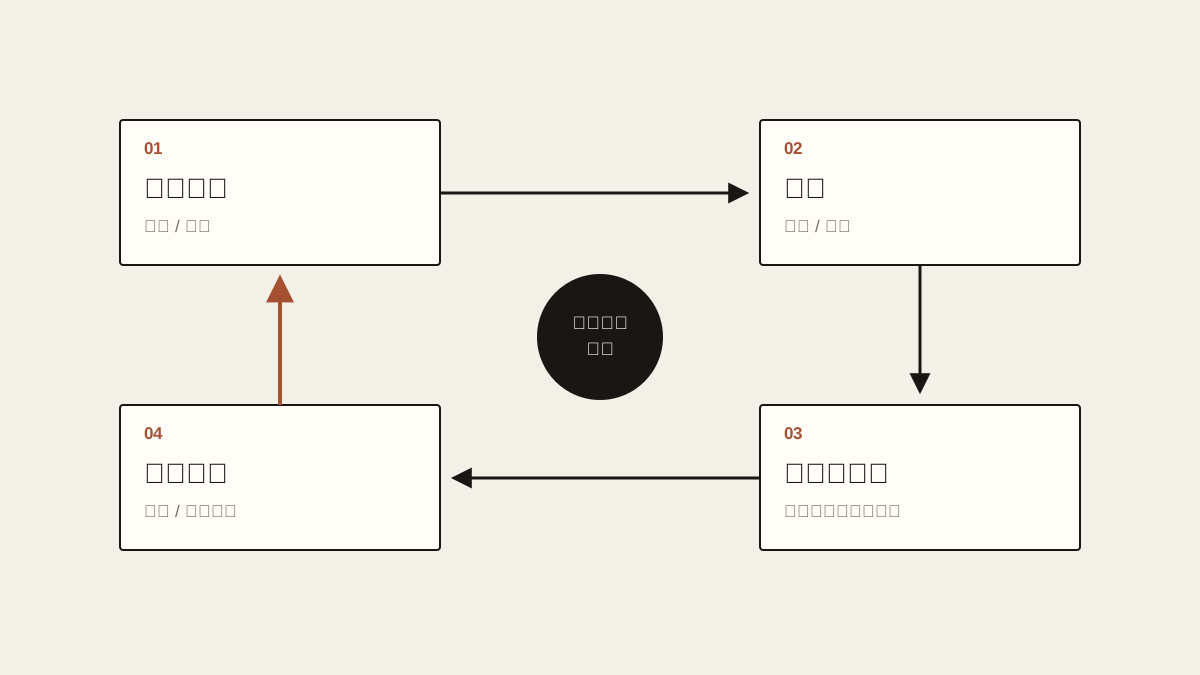
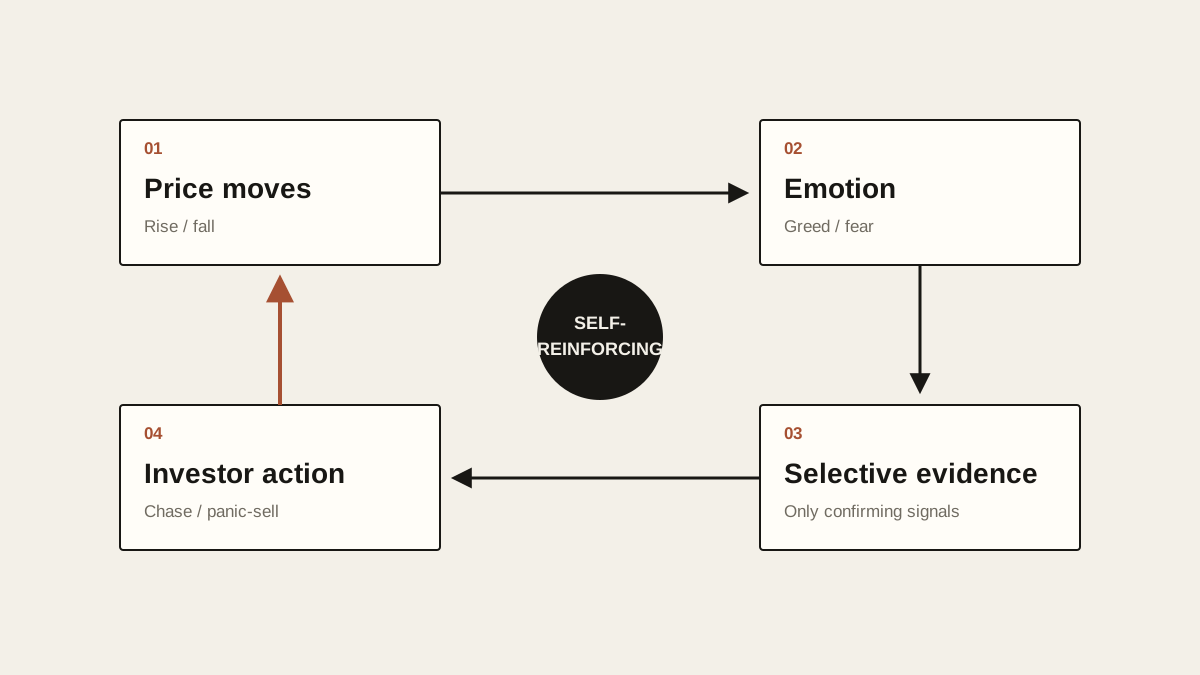
Often, the facts have not changed at all. Only the price has changed. The price changes the mood, the mood filters the information, and the selected information then proves that the mood was right. It forms a loop that is difficult to notice. People usually believe they see evidence first and form an opinion afterward. In reality, the order is often reversed: the opinion comes first, then the search for evidence. In a rising market, a holder actively looks for every reason the rise should continue. In a falling market, the same person begins looking for every reason to sell. The internet makes the problem worse, because almost anything you want to prove can be supported by more than enough material.
If you think the market will rise, you can find dozens of bullish reports. If you think it is about to collapse, you can find dozens of carefully reasoned bearish analyses. There is now too much information for information alone to become an answer. What people see in the market is often not reality itself, but only the part of reality they are willing to see.
Cost basis is another fascinating thing. People become almost emotionally attached to their purchase price. Buy an asset at 100 and watch it fall to 80, and one of the most common thoughts is, “I will sell once it gets back to 100.” That sounds perfectly natural, but on closer examination it has very little logic behind it. The market does not know you bought at 100. The company’s management does not know. Other traders do not know. Future cash flows will not change because of your cost basis.
If the asset is now worth only 50, a rise from 80 back to 100 does not become more reasonable just because you once paid 100 for it. If it is actually worth 200, selling at 100 merely because you have “broken even” makes just as little sense. A cost basis is only a historical record, but in the mind it quickly becomes a psychological anchor. Profit and loss are redefined around that anchor. There is nothing inherently red or green about an asset priced at 80, but the moment a trading app places “-20%” beside it, the experience changes completely.
Much of the time, we are not judging what an asset is worth. We are judging how far it is from “my price.”
There is another powerful force in a bull market: watching other people make money. Losing money yourself is painful, of course, but sometimes it is also painful to watch others profit while you do not. You may have had no intention of investing in something. Then one friend makes 30 percent and you think nothing of it. Another makes 50 percent. Social media starts discussing it, the news begins covering it, and more and more people post screenshots of their returns. One day you start wondering whether you have missed something. The higher the price climbs, the stronger that feeling usually becomes. By the end, the real reason for buying is no longer expected return. It is the fear of being left behind for good.
The memory-chip bull market in the first half of this year gave me a strong sense of FOMO. Whether I opened Douyin or Twitter, it only took a few posts or videos to find people showing off their gains. Shares of companies such as SanDisk, SK hynix, and Micron had risen severalfold. I felt that I did not understand the sector, though, so I did not buy.
This is also why many people show no interest in an asset while nobody wants it, then suddenly develop an intense desire to research it after it has risen severalfold. A rising price creates credibility of its own. Human beings rely heavily on group judgment. In many parts of life, that mechanism works well. A long line outside a restaurant usually means the food is not too bad. A product with 100,000 positive reviews is usually more reliable than one with no reviews at all. Financial markets have a complication: when everyone buys because “other people are buying,” their purchases push the price higher. The rise then validates the rise, more people join in, and eventually the price itself becomes the strongest argument.
The same mechanism works in a decline. Everyone is selling, so the price falls. The falling price then appears to prove that the risk is high, so more people sell. A crowd can create both mania and panic. People standing inside that crowd rarely feel that they are following it. They feel that they have reached an independent conclusion.
Another widespread tendency is to assume that whatever happened recently will keep happening. After a market has risen for several years, people begin to treat rising prices as the normal condition. After it has fallen for a year, they begin to feel that the bad days will never end. History has repeated this pattern countless times. When prices are at their best, the news usually looks its best as well: corporate profits are growing, the economy is thriving, investor confidence is strong, and everyone can find a reason to stay optimistic. When prices are at their worst, conditions are often genuinely terrible: the economy is in recession, companies are laying people off, bad news keeps arriving, and everyone can find just as many reasons to remain pessimistic.
This makes investing deeply counterintuitive. A truly cheap asset rarely feels “safe.” If every problem had been solved and everyone felt confident, the price would probably no longer be cheap. The most expensive moments, by contrast, often feel very comfortable. Your account rises every day, the news is good, the people around you are making money, and the future looks bright. Risk rarely appears wearing a shirt with the word “RISK” printed across it. More often, it looks like certainty.
Investors have an even more troublesome weakness: after making money, they tend to overestimate themselves. If someone enters the market for the first time and makes three good purchases in a row, it is difficult for them to conclude, “Maybe I was just lucky.” A much more common thought is, “I may actually be good at this.” So the original 10,000 yuan becomes 50,000. Relatively simple assets give way to more complicated ones. Someone who once avoided leverage starts to think that using a little probably cannot hurt.
Profit brings more than wealth. It also raises confidence, and confidence encourages greater risk-taking. That is why one of the most dangerous beginnings in investing is sometimes not losing money, but making a great deal of it. A loss at least forces someone to question their method. A string of gains can quickly persuade a person who has never lived through a full market cycle that they have discovered a reliable pattern. By the time serious volatility arrives, the risk they are carrying may be far greater than it was at the start.
This is why talking only about “mental toughness” is not enough. An investor’s psychology is largely shaped by position size. A 30 percent fall in a 10,000-yuan investment and a 30 percent fall in someone’s entire life savings are completely different psychological experiments. The first may make the asset look cheaper. The second may leave the person refreshing prices at three in the morning.
In theory, the same person should reach the same conclusion about the same asset. In practice, a change in position size can turn them into a different person. Every small decline in the market may push a real-life goal a little further away: the money for a home, a child’s education, years of savings, or retirement. Once those goals become tied to the number on a screen, even a calm person will struggle to treat the problem as pure mathematics.
Many so-called problems of investment psychology are therefore problems of risk management at heart. If an ordinary market fluctuation is enough to make someone abandon their original investment logic, one possibility is not that their willpower is weak. Their position may simply have been too large from the beginning. The idea is easy to understand. A person can balance comfortably on a board one centimeter above the ground. Put the same board between two buildings one hundred meters in the air and their body will immediately stiffen. Their ability to balance has not suddenly disappeared. What changed was the cost of making a mistake.

Investing is the same. Many people are exceptionally rational in a paper-trading exercise and become someone else as soon as real money is involved. There is nothing strange about that. Real money creates real emotion.
For the same reason, I have always thought that “stay rational” is almost useless as investment advice. Nobody becomes irrational because they did not know they were supposed to be rational. Fear during a crash needs no teacher. Greed during a long rise requires no training. These responses existed long before modern financial markets. Fear helped our ancestors avoid danger. Following the group improved the odds of survival. Loss aversion helped people protect resources they already had. In the wild, adjusting quickly to recent information may have worked better than slowly building a probability model.
The problem is that we bring a brain designed for survival into a financial market built from numbers, probabilities, and long-term compounding. Many instincts that once helped human beings stay alive can become weaknesses here.
The most effective approach to investing may not be training yourself to become a person without emotions, because such people barely exist. A more realistic approach is to accept that emotions will come, then design rules in advance so those emotions have less power. Before buying, you should answer a few questions. Why am I buying? What exactly do I see in this asset? What would prove my original judgment wrong? What is the largest loss I am willing to accept? If this position loses half its value, will it affect my normal life? If the price rises sharply, has the underlying value really changed, or has only the price changed? If the price falls sharply while the original logic remains intact, what exactly should I do?
These questions are usually easy to answer before buying, when money has not yet begun to influence emotion. Answering them after you hold the asset is much harder. People begin revising their answers, and they usually refuse to admit that they are doing it.
This may be the most important purpose of an investment plan. It is not a prediction of the future, because nobody knows the future. It is more like a contract written by your calm past self for your emotional future self. After the market rises, that future self may believe every asset can keep going up. After the market falls, the same future self may believe the world is about to end. If the emotion of the moment is allowed to rewrite the rules every time, then no investment strategy really exists. There are only immediate reactions.
Of course, this does not mean someone should cling forever to an original view. Refusing to admit a mistake is not discipline. If new facts prove that the original judgment was wrong, changing your mind is the right thing to do. The difficult part is separating two things: did the facts change, or did only the price change? Did the investment thesis fail, or did losing money simply become painful? Is the asset genuinely becoming more valuable, or do you want to believe it is because you have made money?
This may be one of the hardest questions in investing, because we are both judge and defendant. We have to decide whether our judgment has been distorted by emotion, and the decision is still being made by the same brain.
That is why I do not believe that learning a few terms such as “loss aversion,” “confirmation bias,” and “anchoring effect” is enough to overcome them. Knowing that a bias exists does not make it disappear. Many people know that staying up late is bad and still do it. Knowing that a high-sugar diet is unhealthy does not stop someone from wanting dessert when it appears. Human beings naturally seek benefit and avoid harm, and we easily become absorbed in whatever makes us feel comfortable. Investing is no different.
Theory is easiest to understand after the market has closed. The real exam begins when the account is shrinking every day, or when everyone around you is saying, “This time really is different.”
In the end, investing may not be a contest between a person and the market. It is more like a contest between a person and themselves. The market merely keeps producing prices. Fear, greed, regret, hope, envy, and confidence are produced by the person. There is a version of you who becomes more greedy as prices rise, another who becomes more afraid as they fall, and still another who begins to believe they are smarter than everyone else after a run of gains. All of them live in the same body, yet each follows a completely different investment logic.
The person trading against you is never just someone else in the market. It is also your future self.
What a good investment system may really need to do is not predict the next rise or fall with perfect accuracy, but limit the power of that completely different self before they appear.
Because the market’s greatest talent has never been making people lose money directly. It changes their emotions first, then lets them make the losing decision with their own hands.